Sunday, March 23, 2025

THE NO GLUE ZONE!

   Craftsmanship in Custom-Made Clothing:


Why Glue Should Never Be Used

When it comes to custom-made clothing, quality and craftsmanship are paramount. Each piece is a representation of personal style and attention to detail. However, not all custom clothing is made the same, and one key distinction is the method of construction—specifically, the avoidance of glue.


Why Glue Has No Place in Quality Tailoring**


Glue is often associated with mass-produced garments and can compromise the integrity of custom clothing. Here’s why top-notch tailoring relies on stitching instead:


Durability: Stitched seams are far more durable than glued ones, standing up better to regular wear and washing.


Comfort: High-quality stitching allows garments to move naturally with you, offering superior comfort over glued seams that can stiffen with time.


Aesthetics: Stitching provides a crisp, clean appearance that reflects the skill of the tailor, unlike glue, which can create bulk and uneven lines.

  Not All Custom-Made is Equal


The term "custom-made" doesn’t automatically ensure top quality. Consider these factors when choosing a tailor:


Tailor Expertise: An experienced tailor brings artistry and technical skill that enhance the garment's final look.


Material Selection: High-end fabrics not only elevate the appearance but also contribute to the garment’s longevity.


Attention to Detail: From linings to buttons, every aspect should be carefully crafted to maintain the high standards of custom tailoring.


In Conclusion


Choosing custom-made clothing means valuing the craft and skill invested in each piece. Avoiding shortcuts like glue preserves the garment's quality and ensures you receive a product that stands the test of time. Keep these considerations in mind, and enjoy the true luxury of bespoke attire.


Feel free to share this post with your readers on Tailor Talk!


Be Well, Dress Well.


Tuesday, February 27, 2024

Q The Tailor Blog: Maximizing Your Style: The Benefits of Professiona...

Q The Tailor Blog: Maximizing Your Style: The Benefits of Professiona...:   What are professional tailor services? Professional tailor services involve working with a skilled tailor to create custom-made clothing t...

Maximizing Your Style: The Benefits of Professional Tailor Services for Your Wardrobe


What are professional tailor services?

Professional tailor services involve working with a skilled tailor to create custom-made clothing that fits your body perfectly. These services can include altering existing clothing to achieve a better fit, as well as creating new garments from scratch. Tailors can adjust the length, width, and overall shape of garments to ensure they flatter your body and reflect your personal style. Additionally, professional tailors can offer guidance on fabric selection, styling, and fashion trends, providing valuable expertise to help you maximize your style.
tailor services
professional clothing alterations
bespoke tailoring wardrobe enhancements

Benefits of hiring a professional tailor

Hiring a professional tailor can help you achieve a wardrobe that fits you perfectly. Customized clothing offers a flattering fit that can enhance your appearance. Additionally, a tailor can make alterations to your existing clothes, ensuring that they suit your body shape. Tailored garments are typically made of higher-quality
materials
and boast superior craftsmanship compared to off-the-rack options. By investing in tailored clothing, you can enjoy long-lasting items that are uniquely yours.

Customization options for your wardrobe

When working with a professional tailor, you can expect a wide range of customization options for your wardrobe. You can choose from various fabrics, colors, and patterns to create garments that reflect your personal style. Additionally, you can request specific details such as pocket styles, button choices, and lapel shapes to ensure that each piece is tailored to your preferences. This level of customization allows you to have clothing that not only fits perfectly but also aligns with your unique style and preferences.

Importance of proper fitting and measurements


Achieving the perfect fit for your clothing is crucial in enhancing your style. Proper fitting and precise measurements are the foundation of a well-tailored wardrobe. They ensure that your clothing complements your body shape, making you look and feel your best. A professional tailor can take accurate measurements and make adjustments to your garments, providing a comfortable and flattering fit. Additionally, well-fitted clothes can boost your confidence and leave a lasting impression.

Quality of materials and craftsmanship

Quality of materials and craftsmanship are two key factors that make professional tailor services stand out. Professional tailors use high-quality fabrics that are durable and comfortable to wear. They pay close attention to details, ensuring that each garment is meticulously crafted to fit your body perfectly. The precise stitching and construction of the clothing guarantee longevity, providing you with a wardrobe that not only looks stylish but also lasts a long time.

Tailoring services for men's wardrobe

Tailoring services for men's wardrobes are highly beneficial as they provide custom fitting clothing to enhance your style and comfort. Professional tailors can expertly alter suits, shirts, and trousers to ensure they fit perfectly and complement your body shape. By investing in tailored clothing, you can achieve a polished and sophisticated look that sets you apart from off-the-rack options. Additionally, tailored garments are made with high-quality materials and craftsmanship, offering durability and longevity. Whether it's for a special occasion or daily wear, tailored clothing can elevate your style and boost your confidence.

Tailoring services for women's wardrobe

Tailoring services for women’s wardrobe can provide a perfect fit and personalized style for your clothing. Professional tailors can alter dresses, skirts, blouses, and other garments to complement your body shape and enhance your overall appearance. Tailoring can also help you update and rejuvenate old or ill-fitting pieces, giving you a fresh and stylish look without having to invest in new clothes. Whether it's adjusting the hem, taking in the waist, or modernizing the silhouette, a professional tailor can help you achieve a polished and tailored look for your wardrobe.

Alterations and repairs

Professional tailor services can provide alterations and repairs to your clothing, ensuring that your wardrobe fits perfectly and stays in good condition. From hemming to fixing tears, tailor services can help you maintain a polished and put-together look without having to replace your favorite garments.

Finding the right tailor for your needs

When looking for a tailor, consider your specific needs and style preferences. It's important to choose a tailor who specializes in the type of clothing you want to have tailored. Look for someone with a good reputation and experience in working with the materials and styles that you like. Take the time to communicate your preferences clearly and ask about their process to ensure they can meet your expectations. A good tailor will work closely with you to create garments that fit and flatter your body, ultimately helping you to maximize your style and enhance your wardrobe.

Summary: Enhancing your style with professional tailoring services

Professional tailor services can significantly enhance your style by providing personalized clothing adjustments that perfectly fit your body shape. With professional tailoring, you can achieve a polished and sophisticated look that complements your body, giving you confidence in your appearance. Additionally, tailored clothing can improve the longevity of your wardrobe, ensuring that your garments are tailored to your specific measurements, resulting in a comfortable and stylish fit. Whether it's adjusting the hem of your pants or altering the sleeves of your jacket, professional tailoring services can elevate your overall style, creating a wardrobe that reflects your personal taste and refinement.

Wednesday, December 21, 2022

It always about balance

 While fabrics and patterns usually attract the eye first, the suit proportions anchor it in time.

It is always about balance!

A suit extreme in silhouette is more likely to go out of style before it falls apart.

In assessing a suit jacket's potential life span, five elements of design require particular attention; these are the bones of the garment. Should the coat architecture conflict with that of the wearer or; deviate too far from the archetype, the coat's staying power will be significantly weakened.

First Element: The Jacket Shoulder

 As it's the widest dimension, the shoulder sets the mood for the rest of the jacket. 

Since the jacket shoulders the shoulders of the jacket frame the head, if they are too narrow, the head will appear larger then its actual size; conversely, if cut too wide, the head will appear disproportionately small. 

Notice the difference in the shoulder expression between the pictures below.

Sunday, December 26, 2021

SUIT POCKET SQUARES : QUITE A HISTORY !

The pocket square made its first appearance in Antiquity when the Greeks and Egyptians used it as a white linen handkerchief.
In the 14th century, French noblemen would perfume theirs to ward off unpleasant odors. It was adopted throughout Western Europe in the 18th century.


Initially, the pocket square was placed in the trouser pocket. With the advent of the two-piece suit in the 19th century, however, it was tucked into the jacket pocket instead.
It wasn’t until the turn of the 20th century that it became a bona fide fashion accessory.

The return of Dandy styling means the pocket square is now making a comeback, with a modern, offbeat image.


How should you wear it?
The pocket square has evolved from its origins as a plain white handkerchief made of linen or silk and is now available in a wealth of fabrics, colors, and patterns.
Made from silk, linen, cotton, or wool, the pocket square is the finishing touch for your look, providing contrast with a new twist.


If you’re wearing a light-colored suit, choose a pocket square in dark shades or bright colors. Conversely, if you're wearing a dark suit, go for a light-colored pocket square.
Be bold and have fun with fabrics, folds, and colors!
Never wear a matching tie and pocket square, though: the aim is to break the color code, especially if your tie is a vibrant color, and add either a fresher feel or some warmth to your outfit.

And you, how do you wear your pocket square?


Monday, August 10, 2020

Pattern History

 Designing Women?

In 1859 the first paper patterns for clothing are sold. Their male American creator cashes in on the snob appeal of all things French by calling them "Mme. Demorest’s Mirror of Fashions." It worked. Patterns for cloaks (37 cents), infants' clothes (12 cents), and "fancy dresses" ($1.00), are snapped up by American women.

 Before patterns, clothes are cut to size in of two ways: a new garment is made either by copying an old one or tailor made-to measure by basting a rough shape of the garment cut from muslin on the wearer, and reworking it until the seamstress gets the fit right! 

 that they are immediately popular. and chi, too. Queen Victoria sends to America for Butterick patterns to have suits made for her sons.


Tuesday, December 26, 2017

Q The Tailor Blog: A CENTURY OF EXCELLENCE

Q The Tailor Blog: A CENTURY OF EXCELLENCE: OXXFORD CLOTHES SHARES SUCCESS SECRETS AND PLANS FOR THE NEXT 100 YEARS   While it might not be the most accessible custom suit out ther...

A CENTURY OF EXCELLENCE

OXXFORD CLOTHES SHARES SUCCESS SECRETS AND PLANS FOR THE NEXT 100 YEARS

 While it might not be the most accessible custom suit out there, there are few clothing brands with as compelling a story as Oxxford, now 100 years old. Their commitment to quality, luxury and American production sets them apart for legions of consumers, including United States presidents, Hollywood stars, prominent politicians, corporate CEOs and successful entrepreneurs. (Editor’s note: Stanley Marcus was a huge Oxxford fan.) The common denominator for the past 100 years: men wear Oxxford because they want the very best.
Here, we speak with Oxxford’s president Bob Denton and sales director Chris Brueckner about how they hit this 100-year milestone, and how they plan to approach the next century.
Q: To what do you attribute the longevity of this highly esteemed luxury brand?
A: Oxxford Clothes’ mission has always been “to create a garment by which all others will be judged.” We have remained true to that mission. We are arguably the only production garment in the United States that is totally made by hand. For example, we allow the artisans who hand-pad our lapels 30 minutes to complete each lapel with approximately 1,000 hand stitches. One person can complete only about seven garments per day. There are 179 steps in the production of an Oxxford suit, which takes approximately 28 hours of labor.
The brand’s longevity is a combination of a couple of things. There is always demand for the best. When Oxxford started, their goal was to make a superior suit. Both retailers and their customers realized there was a difference in an Oxxford garment and it became what everyone measured their tailored clothing against.
The reality today is that many guys have switched to designer and global brands, a more casual style of dress and (lately) made-to-measure and direct-to-consumer clothing. While these trends have been the demise of many tailored clothing companies, Oxxford has been able to adapt to changes, thanks to supportive ownership and a continuing commitment to quality.
Our success can be attributed to maintaining quality, flexibility and growing our consumer base. While our core customer is older, we’re getting lots of interest from younger guys. They’re interested in the “heritage” of the brand, the process of the make, and the customization possibilities. Most can’t do the “spend” yet, but these are our future customers. They want authentic clothing.
Q: So how do you attract younger guys who want Oxxford but can’t afford it?
A: Our social media campaign has dramatically helped raise awareness of Oxxford Clothes with a younger consumer. We have become an aspirational brand for the new generation of gentlemen that appreciates the heritage, artistry and quality of what we produce. Several years ago, an extension brand, Oxxford 1220, was introduced. It’s still a high-quality garment, made in our Chicago factory, but we eliminated some of the more meticulous, time-consuming processes. It changed our ready-to-wear business and did some harm where the end consumer thought he was buying the same Oxxford he had in the past.
All the handwork in an Oxxford garment serves a purpose: it is the only way to put permanent shape into a lapel and collar. And shaping the chest like we do, an Oxxford garment has a give that provides movement that a non-handmade garment cannot claim.
What we do best is make hand-made clothing. It’s who we are, part of our 100 years of success. (We still offer the 1220 product to a few accounts. It’s a great value, but we prefer to focus on our highest quality make.)
Q: How’s current business? What’s selling best?
A: We finished ahead of our forecast for 2016. While we are closely held and do not publicize our numbers, I can say that we remain profitable. We recognized the coming shift several years ago from ready-made clothing to the future demand for more custom and adjusted our production accordingly.
That move set us up to capitalize on the change that has in fact taken place. Ready-made is still an important part of our business: stores must have garments to show and use for fittings. But our production has shifted to mostly custom.
Q: What else do you have planned for this year?
A: For 2017, we won’t stray too far from our classic looks, but we’re focusing on more luxury fabrics in cashmere, and wool/silk blends. We’re reintroducing Escorial wool for both suits and jackets. We now offer more color in jackets and we have a strong presentation in blazer fabrics.
Our new models are slightly trimmer: one is our version of a “soft coat” with a lightweight make and details. The other has a slightly stronger shoulder and narrow waist for a more sartorial expression.
Q: So future growth will come from new product offerings and more custom?
A: Yes, we are growing both with our current retail partners and with new accounts. We have a unique story and product and will continue to focus on what we do best. We also expect to gain market share from competitors who are getting into the retail business and selling directly online, thereby competing with the stores that built up their business for them. I think retailers will be more likely to support brands that are not competing directly with them.
Q: How many wholesale accounts do you have? And why is there just one retail store?
A: We have approximately 90 active wholesale doors. Our flagship in New York is our only company store. Although it’s important for our brand image to have a retail presence in the city, our expertise is making the finest clothing in the world. We are manufacturers. We have a tremendous amount of talent with retail experience within our company; we’d rather use that talent to help our retail partners than to compete with them.
In Features by Karen Alberg Grossman 

Wednesday, August 16, 2017

Q The Tailor Blog: Knickerbockers For 2017?

Q The Tailor Blog: Knickerbockers For 2017?: Knickerbockers Knickerbockers are men’s breeches or baggy-kneed  trousers  especially well-liked in the early  twentieth century  USA. ...

Knickerbockers For 2017?

Knickerbockers

Knickerbockers are men’s breeches or baggy-kneed trousers especially well-liked in the early twentieth century USA. Golfer’s plus twos and plus fours wear breeches of this type. Before World War II, skiers frequently wore knickerbockers also typically ankle-length.
Until after World War I, in several Anglophone countries, boys habitually wore short pants in summer and knickerbockers or “knickers” or “knee pants” in winter season. At the beginning of teenage years, they graduated to long trousers. In that era, the changeover to “long pants” was a major practice of passage.
For example, the classic song Blues in the Night by Johnny Mercer: “My mammy done told me, when I was in knee-pants, my mammy done told me, son…”
Baseball players are dressed in a stylized form of knickerbockers, even though the pants have become less baggy in modern decades and some contemporary ballplayers opt to pull the trousers seal to the ankles. The white trousers worn by American football officials are knickerbockers, and while they have become less baggy, they are still worn ending shortly below the knee. In topical years, the NFL has equipped its official with long trousers rather than knickers in cold weather conditions.

UTILIZE IN SPORTS ACCOMPLISHMENTS

Knickerbockers have been well-accepted in additional sporting endeavors, particularly golf, rock climbing, cross-country skiing and bicycling.
Certainly in cycling, they were standard clothing for almost hundred years, with the majority of archival photos of cyclists in the period before World War I showing men wearing knickerbockers tucked into long socks. They stay behind fairly popular in Britain where they were called “breeks” or “trews” in the years between World War I and World War II, but ultimately were concealed in attractiveness by racing tights, even between the enormous majorities of cyclists who never raced.
Invariably referred to as “knickers” in the US, where the British definition of that term is unidentified, they lived on as a just-past-the-knee modification of racing tights reserved for colder-weather riding.
During the period of beginning of the year 1980s, media attention in the then-Lady Diana Spencer brought a epigrammatic commercial renewal of the look in women’s and unisex fashion both in the places Europe and North America which were predominantly along with the “town and country”, “New Romantic” and “preppie” sets. However, by 1984 the style had diminished as more top-heavy styles with snug pants rendered the style obsolete.

Monday, May 15, 2017

Q The Tailor Blog: ARE TAILORED CLOTHING SALES REALLY DECLINING OR IS...

Q The Tailor Blog: ARE TAILORED CLOTHING SALES REALLY DECLINING OR IS...: ARE TAILORED CLOTHING SALES REALLY DECLINING OR IS THE BUSINESS SIMPLY MOVING TO CUSTOM-MTM?  by  MR Magazine David Rubenstein from Ru...

ARE TAILORED CLOTHING SALES REALLY DECLINING OR IS THE BUSINESS SIMPLY MOVING TO CUSTOM-MTM?

David Rubenstein from Rubenstein's in New Orleans asks:
  Have there been any recent studies comparing “rack clothing” business to custom/MTM? Our custom business is really growing since we’ve been promoting it. I also see that young merchants who’ve recently started in the clothing business are really pushing custom. During the MRket show in NYC, the “custom designer” group showed at the Warwick. These are young entrepreneurs who go door to door. Then there is Tom James, already surpassing $500 million in sales and aiming for a $1 billion in the next few years.
So I’m curious if the clothing business is really shrinking or just moving to custom? And to what extent are traditional retailers losing business to this trend? We find these new young customers are NOT brand loyal: they don’t know brand names but only the names of their custom sales associates. These customers like the way they look in a fitted suit but don’t want to see themselves coming and going. They know what they want their suit to look like and will go to the person who can execute their vision. Once they find that person who can understand and fit them, they’re loyal. They don’t want to go through re-measuring at another store.
I also find that, since computers, there are more sales associates on the road who have started carrying custom clothing lines. Europe and the Far East have introduced an incredible number of manufacturers who can make a custom suit in a week (less time than doing a suit in a store tailor shop). This also reduces in-store alteration costs.
I’d love to hear what others clothing industry execs have to say about this trend.

Wednesday, November 30, 2016

Q The Tailor Blog: Do you know your shirt fabrics?

Q The Tailor Blog: Do you know your shirt fabrics?: Dress Shirt Fabrics Overview Here we provide the definitive overview of the different types of fabrics commonly used in dress shirt...

Do you know your shirt fabrics?


Dress Shirt Fabrics Overview


Here we provide the definitive overview of the different types of fabrics commonly used in dress shirts.  By understanding what the different weaves mean for a fabric you can be sure to find the ideal dress shirt fabric for your needs.

Broadcloth
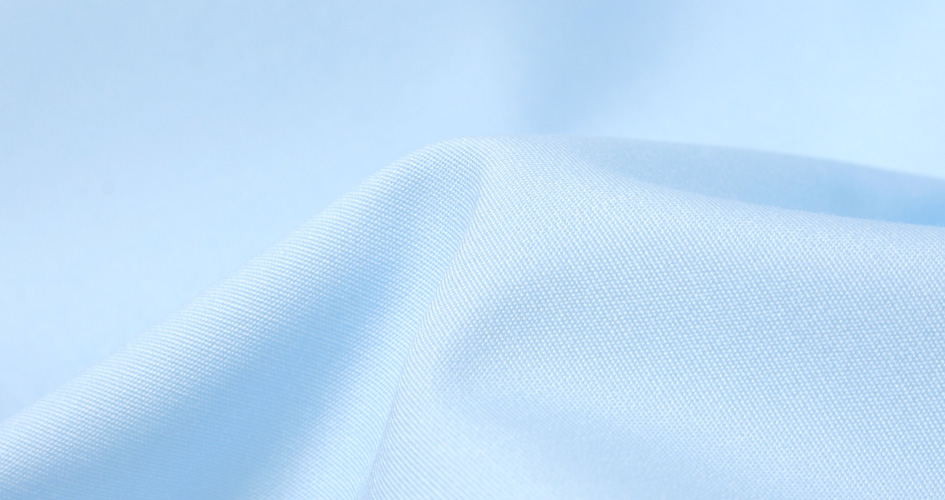
Broadcloth—often referred to as poplin–is a tightly woven fabric with a very simple over-under weave and very little sheen, which makes it nice and professional. Broadcloths are great for guys looking for as little texture as possible in their fabrics. They are generally a thinner, lighter fabric. Particularly, white broadcloth fabrics can be slightly transparent. Broadcloths generally wear the smoothest out of all weaves thanks to their lack of texture, but can also be the most prone to wrinkling.
Learn more about broadcloth fabrics here or browse our selection of broadcloth fabrics here.
Broadcloth Dress Shirt Fabric

Twill

Twill fabrics are easily recognizable because they will show diagonal weave or texture. The diagonal effect can range from very fine, subtle twills to much larger Imperial or Cavalry twills. Twills will almost always have a bit of shine, though the degree can depend on the weave, color, and cotton used. Twill is an extremely tight weave,  that can come in extremely high thread counts, some of which might be mistaken for silk. Because of the diagonal texture twill is a bit softer than broadcloth and will drape more easily. Twill won’t give you the same “crisp” look that freshly pressed broadcloth can, but it’s relatively easy to iron and resistant to wrinkles.
Learn more about twill fabrics here or browse our selection of twill fabrics here.
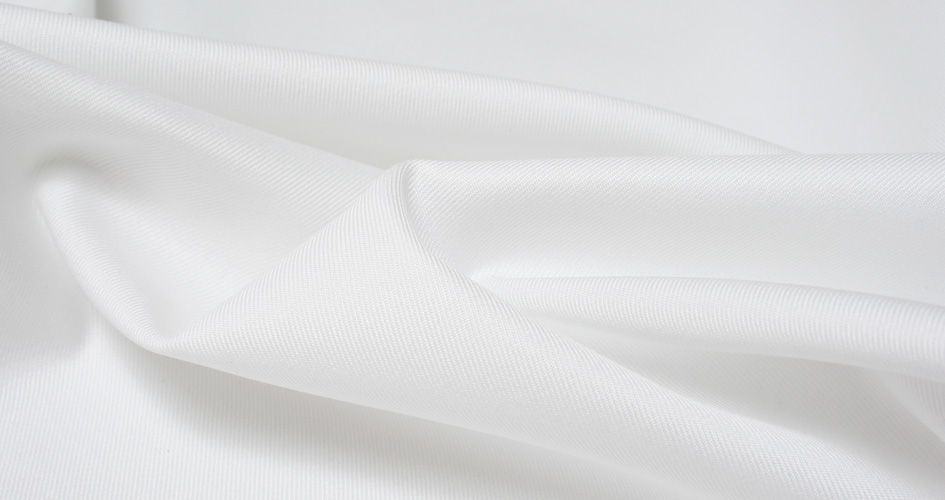
Twill Dress Shirt Fabric

Pinpoint Oxford

Pinpoint (also referred to as pinpoint oxford) has the same weave as oxford cloth, although it uses a finer yarn and tighter weave. It is more formal than oxford cloth, but less formal than broadcloth or twill. Think of them as great everyday work shirts, but not necessarily the first recommendation for special events. Pinpoint fabrics are generally not transparent and are slightly heavier and thicker than broadcloths. Because of their heavier construction, pinpoints are fairly durable fabrics. Opt for a twill or broadcloth if you’re looking for a formal shirt.
Learn more about pinpoint fabrics here or  browse our selection of pinpoint fabrics here.
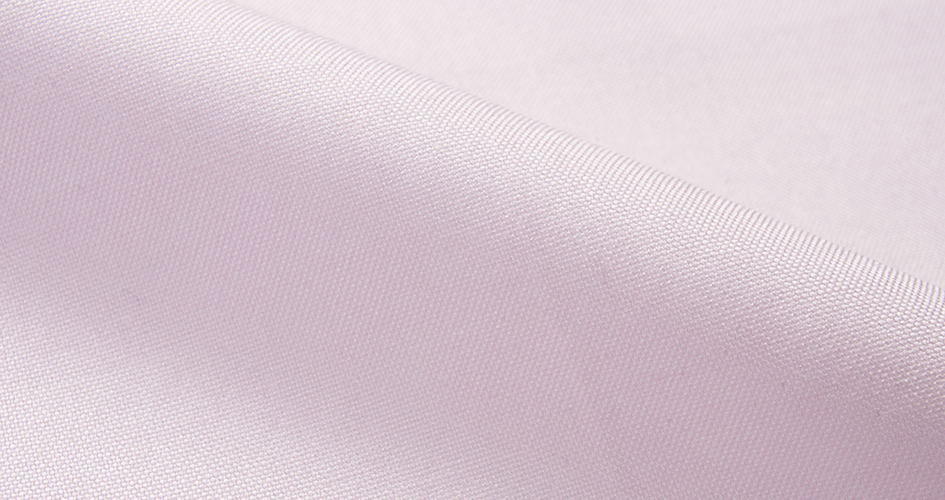
Pinpoint Dress Shirt Fabric

Chambray

Chambray is a plain weave fabric.  That means it has a similar construction to broadcloth, though it is generally made with heavier yarns for a more relaxed or workwear appeal. Generally there will be white threads running in the weft/width direction such that the fabric has an inconsistent color to it.  This could be compared to an end-on-end, though chambray is generally much heavier and more appropriate for casual wear than dress.
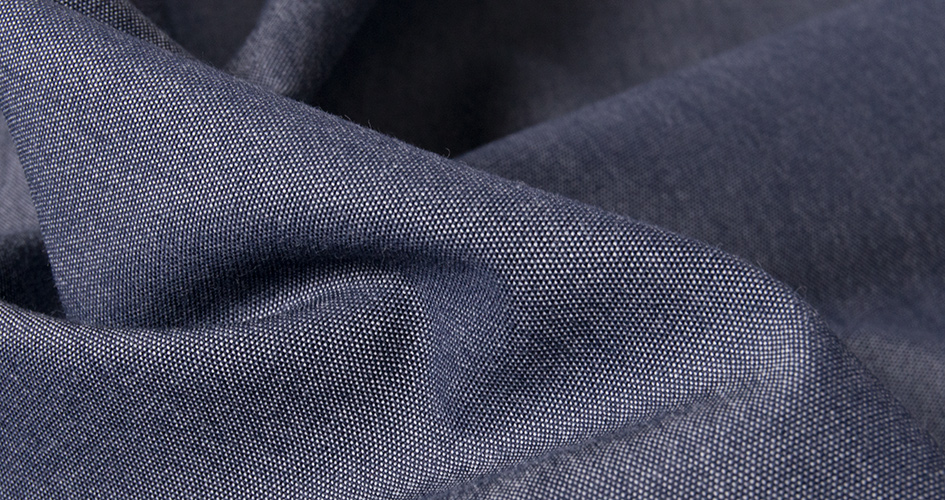
Chambray Fabric
Chambray Fabric

Denim

We all know denim as the fabric of our jeans.  But construction wise, denim is a twill fabric. A sturdy, possibly coarser twill often dyed with indigo.  For the most part though, when it comes to denim shirting, you’re mostly going to find much softer, lighter versions of the fabric than what your jeans are made of.  Denim shirting can come in many forms but generally have a different color on the inside than the outside.
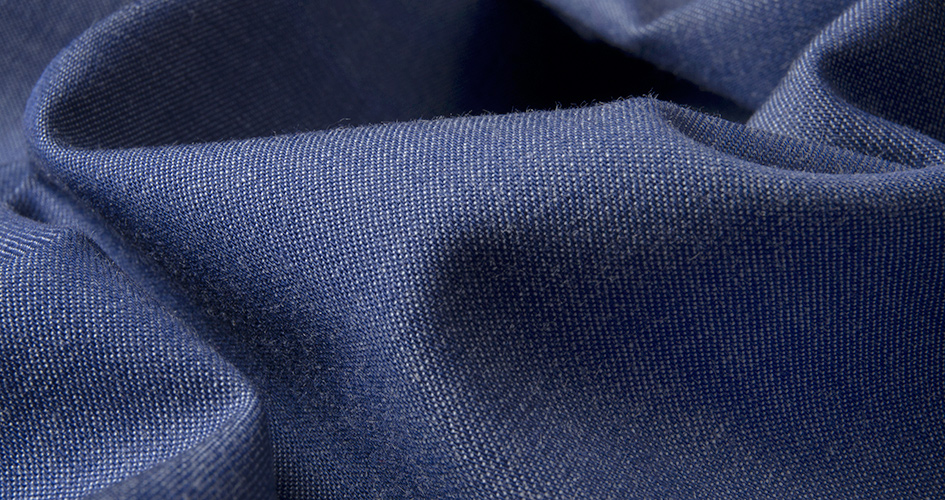
Denim Shirt Fabric
Denim Shirt Fabric
Dobby
Dobby (which is very similar to Jacquard, although technically different) can vary widely. Some versions are quite similar to broadcloth in terms of thickness and weight, while others can be thicker or woven to almost look like twill. Many dobby fabrics have stripes woven into them, although some are solid colors. The solid colors tend to have a faint stripe or dotted patterns woven in the same color as the base cloth.
Learn more about dobby fabrics here or browse our dobby fabrics here.
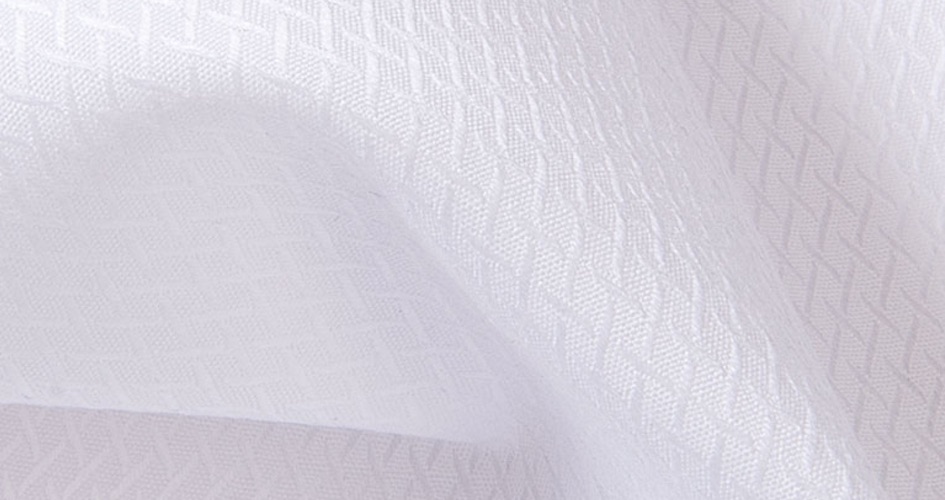
Dobby Dress Shirt Fabric

End-on-End

End-on-end broadcloths are a very popular type of dress shirt fabric with a distinct contrast coloring. Woven with colored thread in the warp and white thread in the weft, it looks like a true solid from a distance, but has more texture when seen from up close. Typically a lighter weight fabric, it’s a great choice for those living in warmer climates.
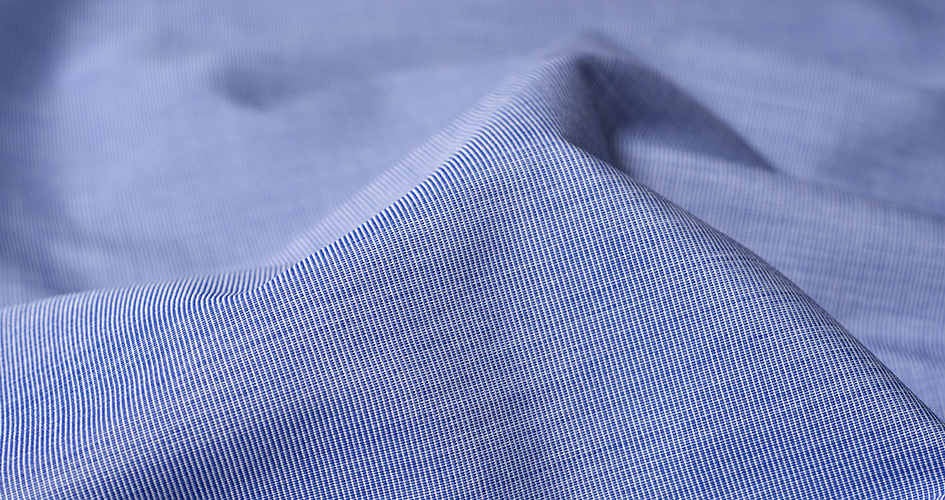
End on End Dress Shirt Fabric

Flannel

A fall/winter favorite. Flannels are warm, fuzzy fabrics that are most often brushed twill or brushed poplin fabrics. While they’re most regularly 100% cotton, they sometimes can come in cotton/wool, and even cotton/cashmere blends for added warmth. Usually made in thicker weaves, these are decidedly casual fabrics that are great for cold weather.
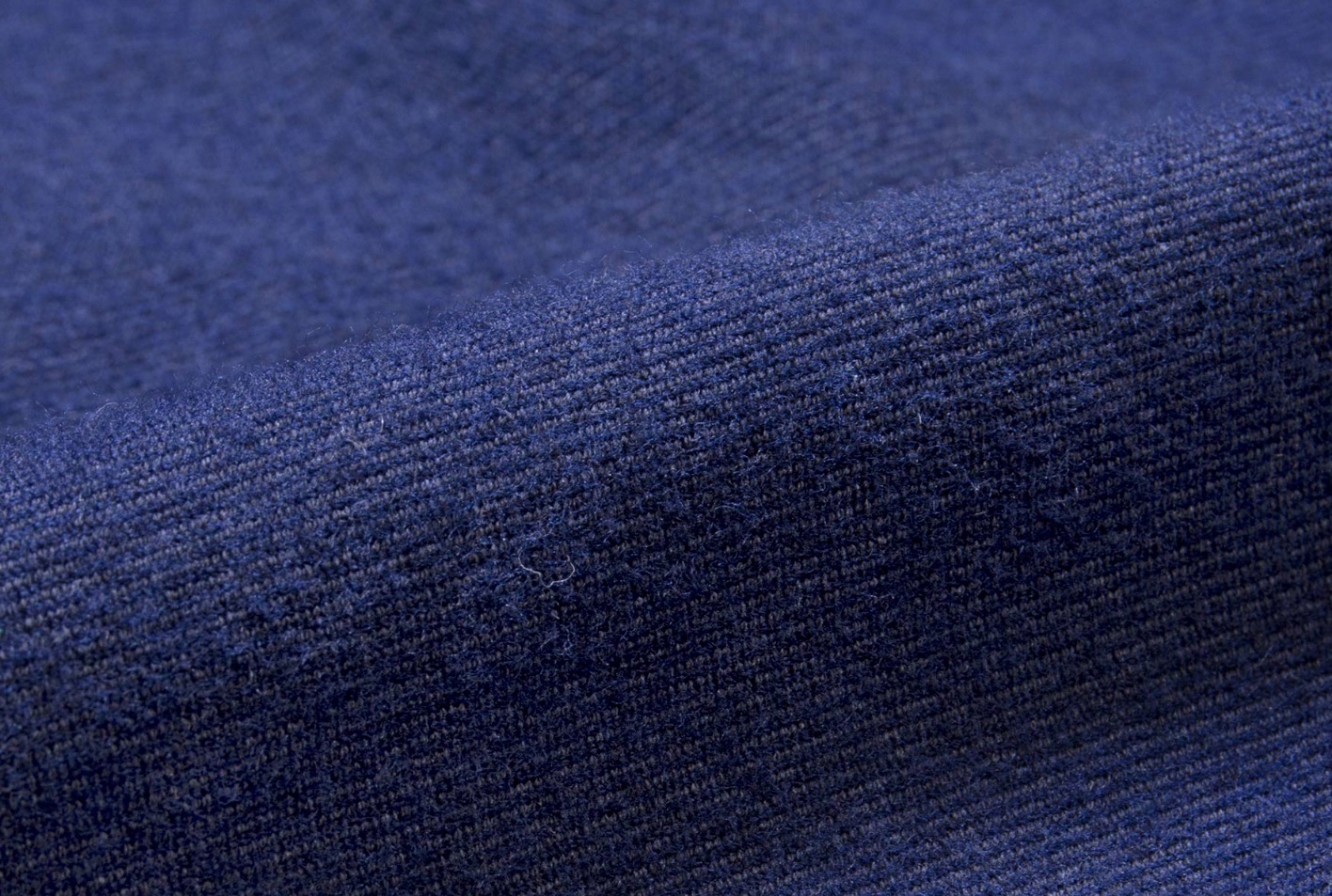
Flannel Dress Shirt Fabric

Melange

Melange fabrics can come in every sort of weave–poplin, twill, royal oxford, etc–and are woven using multi-colored yarns. Each yarn will be dyed this way, most often with 2-3 subtlety different hues.  These unique yarns can help achieve a heathered, intentionally inconsistent, somewhat organic look. Melange fabrics are different than Mouline fabrics, as Mouline fabrics are made from consistent, one-color yarns that are twisted together to achieve a multi-color look.
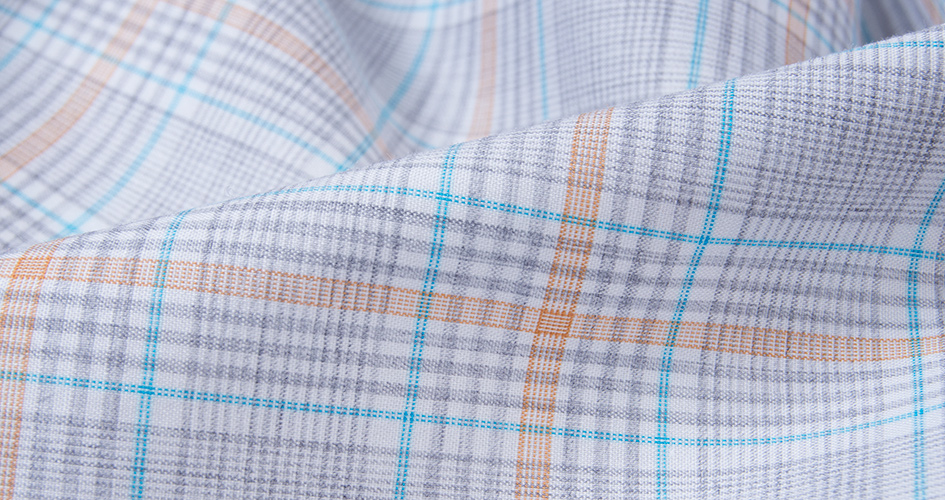
Melange Dress Shirt Fabric

Oxford Cloth

Oxford Cloth is very similar to pinpoint oxford, except it uses a slightly heavier thread and looser weave. It has a slightly rougher texture but is more durable than most fabrics. It’s composed of a symmetrical basketweave where one yarn may cross two yarns. Originally developed for sportswear, so it’s the least dressy, and (in some circles) not considered appropriate for office or formal wear. Oxford cloth has always been a staple in traditional American button down polo shirts. It can be worn slightly wrinkled straight from the dryer and still look great.
Learn more about oxford cloth here or browse our selection of oxford cloth here.
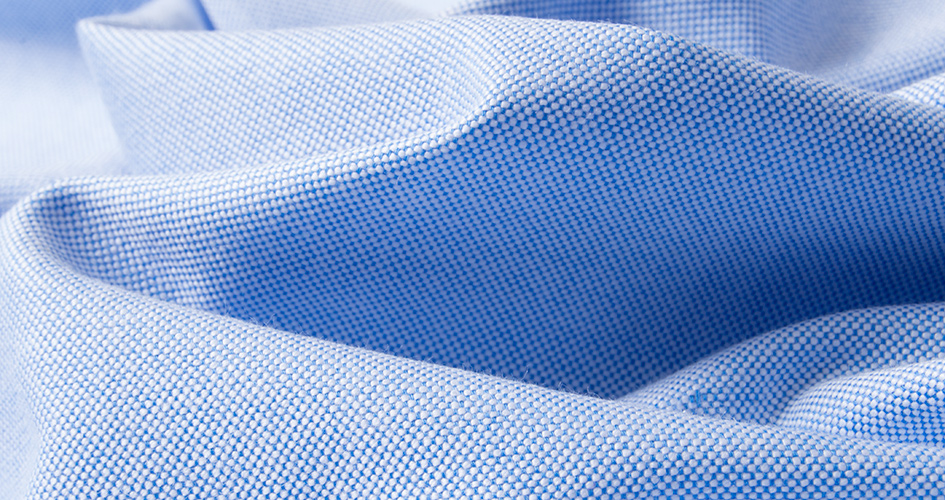
Oxford Cloth Shirt Fabric

Poplin

Poplin is so similar to Broadcloth that we decided not to distinguish between the two in our fabric descriptions.  For all practical purposes you can equate the two. They are both a plain weave fabric that is going to be quite thin, smooth and flat. That said, technically Poplin is different than Broadcloth in that Poplins can have different weight yarns in the warp and weft while broadcloths will have a a symmetrical construction.  For example, broadcloths could be 100/2×100/2 (meaning 100s two-ply in the warp and weft) while a poplin could be 100/2×60/1 (meaning 100s two-ply in the warp and 60s single-ply in the weft).
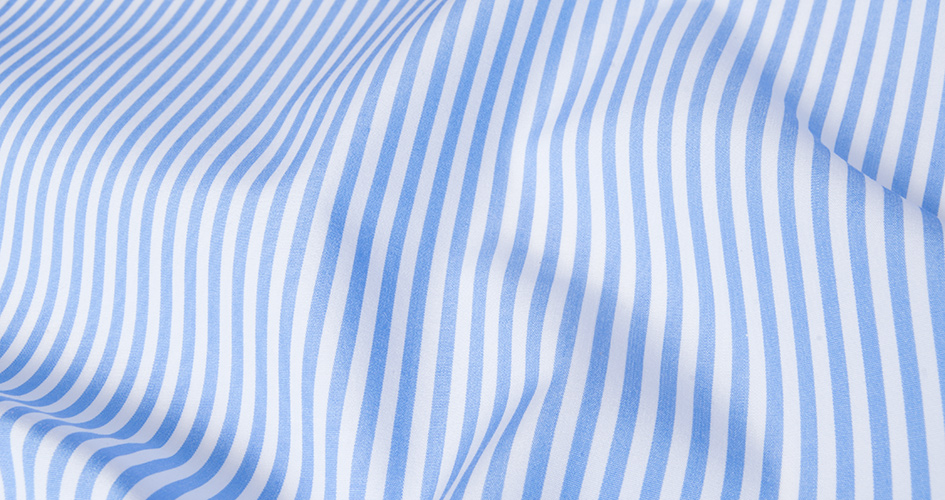
Poplin Dress Shirt Fabric

Royal Oxford
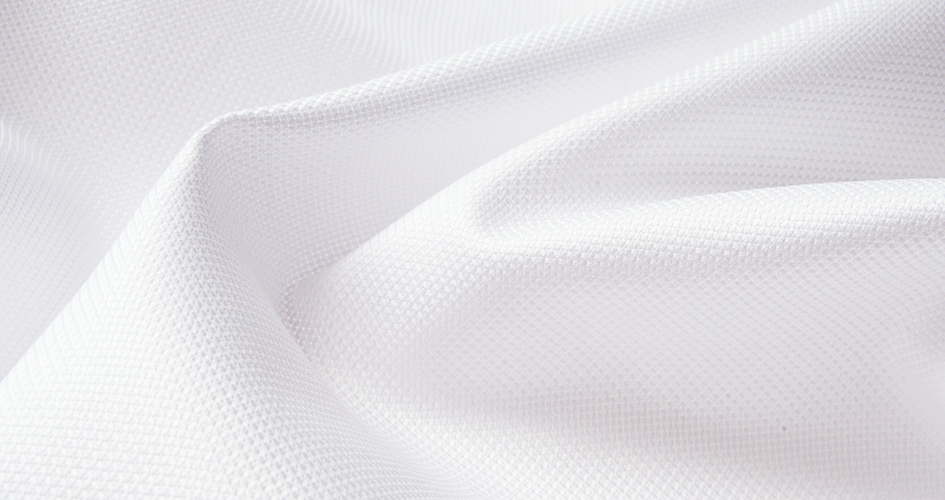
Royal Oxford is what we call a “pretty fabric”. Although the name is similar, it is not at all similar to pinpoint oxford or oxford cloth. It is a dressy fabric with a distinctive shine and texture. With a more prominent weave than broadcloth or pinpoint, it’s ideal for those interested in a dress or formal shirt with visible texture.
Learn more about royal oxford fabrics here or browse our selection of royal oxford fabrics here.
Royal Oxford Dress Shirt Fabric

Herringbone

Herringbone shirts are popular, more textured shirts for both dress and casual wear. Herringbone is essentially a twill that is mirrored when woven to create the sort of chevron, “V-shaped” look. The fabric’s name comes from its resemblance to the bones of a herring fish.

Seersucker

Seersucker is a fabric primarily used to make shirt for warm weather, and is is known for its distinctive, puckered appearance. This puckered look is created in the finishing of the fabric, after it’s woven, and helps to promote air flow while being worn. This helps make seersucker very comfortable in the summer. While seersucker fabrics can come in any color or pattern, blue striped seersucker is most popular.
Linen
Linen fabrics are incredibly breathable and, like seersucker, typically made to be worn in hot climates. Linen is made from fiber of the flax plant, and can be very labor intensive to produce. Typically linen will be more loosely woven and sheer than most cotton shirts, and has a very unique dry hand to it that is unlike cotton. Linen also tends to wrinkle more easily than cotton and generally feels much more relaxed because of this. While we love the look and feel of linen, some people prefer cotton/linen blended shirts as you can achieve much of the coolness of a linen shirt while reducing the wrinkling.

Egyptian, Sea Island, and American Pima Cotton

When you hear about Egyptian, Sea Island, or American Pima cotton you should know that this is not referring to the type of weave, but to the type of cotton used to make the weave. For practical purposes, Pima cotton, Sea Island and Egyptian cotton are all cottons derived from originally the same plant: Gossypium Barbadense. These are more desirable cotton because they are typically “extra-long staple length” cottons (length greater than 1 3/8″), which allows them to be spun into finer, stronger yarns.
All three of these cottons are typically regarded as high-end, luxury raw goods. Egyptian and American Pima will be the most readily available, while Sea Island cotton is well-known for being incredibly rare. Often, American Pima will be woven into fabrics of a slightly lower quality than Egyptian as it is not as clean of a fiber, despite having similar staple lengths.
There is also a famous, rare form of Egyptian cotton called “Giza 45″ that is specially used for some of the world’s finest shirting fabrics–notably Thomas Mason Goldline fabrics. This is a highly acclaimed form of cotton found in a particular portion of the Nile Delta, that can be woven to produce incredibly fine yet strong yarns. Fabric made from Giza 45 cotton tends not to degrade over time as much as other Egyptian or American Pima cottons.
Accounting for just .0004% of the cotton supply available, Sea Island Cotton is the rarest in the world. What makes Sea Island Cotton so desirable is it’s unique combination of characteristics: extra long staple length, remarkable fiber strength, incredibly uniform growth, and a significant brightness in color.
While other high-end shirting cottons like Egyptian cotton and American Pima can boast extra-long staple length above 1 3/8″, it’s Sea Island Cotton’s durability, consistency, vibrant color, and silky luster that makes it different from these. The uniformity, strength, and “hairlessness” of the fiber allows fabric woven from it to last an incredible long time, and actually become smoother each time they’re laundered.
The best Sea Island Cotton comes from Barbados because incredibly uniform, humid climate of the island allows for the cotton plants to grow in a consistent way throughout the year. The cotton in Barbados is also picked by hand to ensure the highest quality levels.
Making matters a bit confusing, there are trademarks filed around the names “Sea Island” and “Supima”. Keep an eye out for “Certified Sea Island Cotton” vs. “Sea Island Quality”, as only the former will be authentic and it’s something we often see on the market.
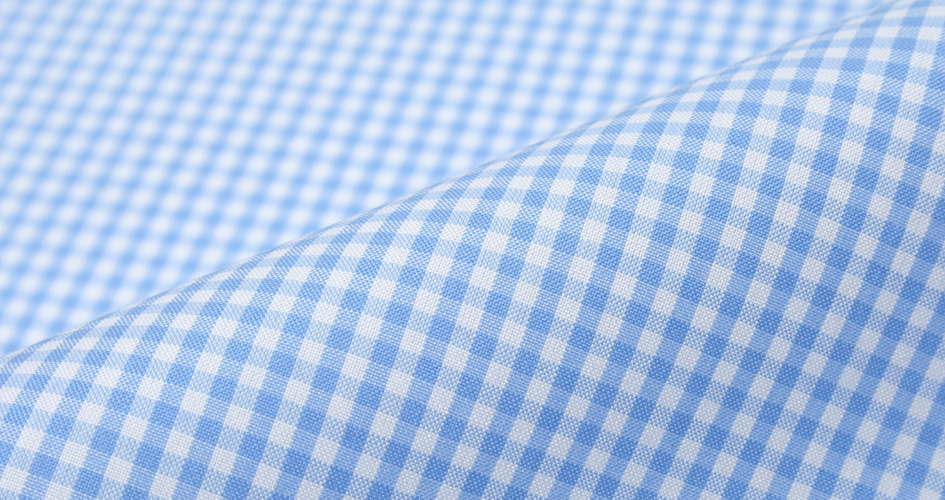
Premium Egyptian Cotton Dress Shirt Fabric
Egyptian Cotton Dress Shirt Fabric

Thread Count

If everything else is the same (weave, ply, mill, and type of cotton), higher thread count means a smoother, silkier, more expensive fabric. Thread count is often referred to with a number like 50s, 80s, 100s, 120s, 140s, 170s, etc up to 330s.  These numbers refer to the yarn size, but keep in mind that typically a thread count above 100 will imply a 2-ply fabric.
Though there are some exceptions when extremely fine single ply yarns are used, these higher number thread counts will be two yarns twisted together. For example, 120’s thread count means that two 60’s yarns are twisted together. Generally this fabric will be more durable than a 60’s single ply, but it won’t necessarily be smoother. 140’s thread counts are typically two 70’s yarns twisted together. And so on and so forth
While thread count can be an indicator of quality, remember that ply, mill, and quality of cotton will have just as much to do with how luxurious the fabric is.

Two Ply vs Single Ply

Ply is how many yarns are twisted together to make a single thread. Shirting fabrics are most often two-ply or single ply. Two-ply means that two yarns are twisted together to make a single thread that is then woven into the fabric. (Note that this is not at all like two-ply toilet paper!). Two-ply fabrics are generally superior to single-ply fabrics in their durability. Three-ply fabrics are rare, but can be found occasionally.